


Amid the exceptional circumstances facing Lebanon, the Municipality of Qaraoun and the Union of Lake Municipalities have issued an urgent appeal for support to address the escalating environmental and humanitarian challenges in West Bekaa, driven by the increasing influx of displaced populations fleeing the war in the south.
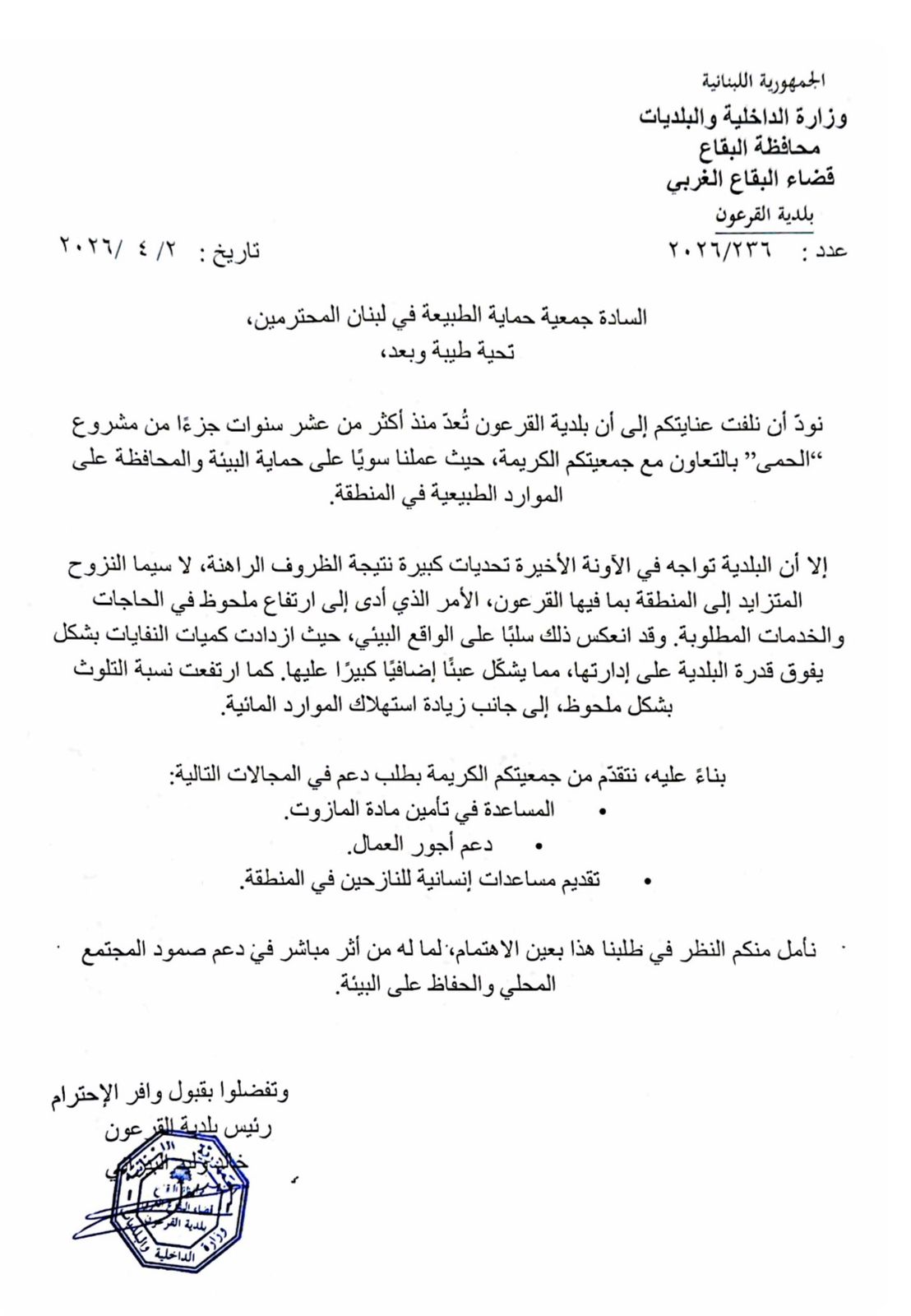
In a letter addressed to the Society for the Protection of Nature in Lebanon, the Municipality of Qaraoun, a key partner in the Hima project for more than a decade, reaffirmed that this model has played a vital role in protecting natural resources and promoting sustainable environmental management in the region. However, current pressures have exceeded the municipality’s capacity, as the growing displacement has led to an unprecedented surge in demand for basic services, particularly waste management and water supply.
The municipality noted that waste volumes have risen beyond its operational capacity, alongside a marked increase in pollution levels and the depletion of water resources, posing a direct threat to both the environment and public health.
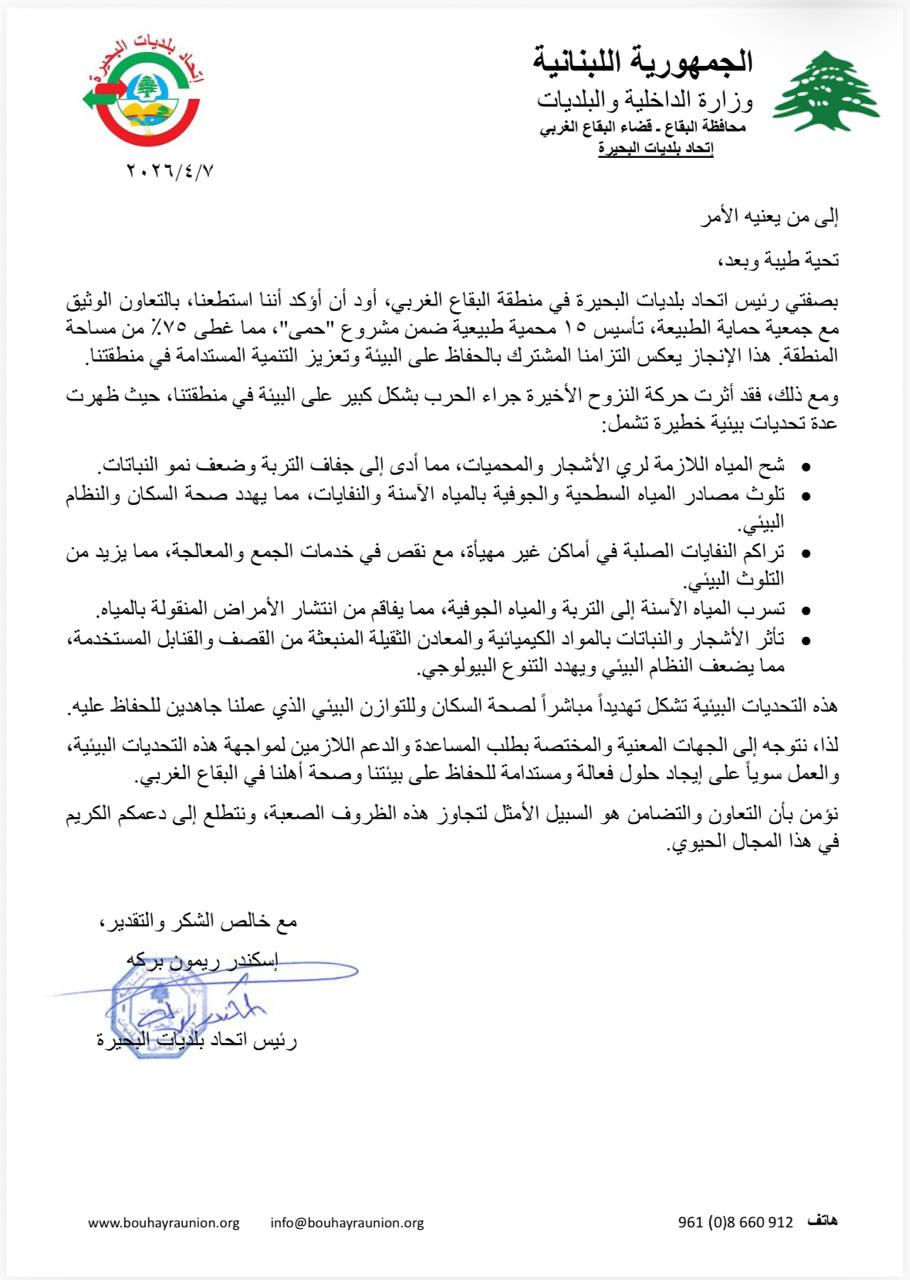
For his part, the President of the Union of Lake Municipalities highlighted that cooperation with the Society for the Protection of Nature has enabled the establishment of 15 nature reserves under the Hima model, covering approximately 75% of the area. This achievement reflects a strong commitment to environmental protection and sustainable development. However, this environmental system is now under severe strain due to the impacts of displacement.
The Union also outlined a number of serious environmental challenges, including water scarcity affecting irrigation of trees and reserves, contamination of surface and groundwater sources, the accumulation of solid waste amid limited collection and treatment services, leakage of wastewater leading to the spread of waterborne diseases, and the impact of chemical substances and heavy metals from shelling on vegetation and biodiversity.
The municipalities warned that these developments pose a direct threat to public health and to the environmental balance that has been built over years of joint efforts.
In this context, the Municipality of Qaraoun and the Union of Lake Municipalities called on donors and relevant institutions to act urgently and provide support in key areas, including:
- Securing fuel to ensure the continuity of municipal services,
- Supporting workers’ wages,
- Providing humanitarian assistance to displaced populations,
- Strengthening waste management capacities and protecting water resources.
The municipalities emphasized that cooperation and solidarity are the only way to overcome this compounded crisis, stressing that investing in municipal support today is a direct investment in community resilience and environmental protection in Lebanon. They also underscored the urgency of immediate action, as West Bekaa stands at a critical turning point, where a swift and effective response can prevent deeper environmental and humanitarian deterioration and preserve the Hima model as a cornerstone of sustainable development in Lebanon.
West Bekaa is now at the frontline of a complex humanitarian and environmental crisis. The influx of displaced families is placing unprecedented pressure on fragile municipal systems and natural ecosystems alike.
Municipalities such as Qaraoun, a long-standing partner in Lebanon’s Hima network, have openly warned that their capacity has been exceeded. Authorities report surging waste volumes, rising pollution levels, and increased pressure on already scarce water resources. They are urgently appealing for support to secure fuel, sustain municipal workers, and provide humanitarian assistance to displaced families.
This appeal reflects a broader reality: local governance structures are struggling to maintain even the most basic services, raising the risk of systemic failure if rapid action is not taken.
Nature-Based Solutions Under Threat
Amid this crisis, Lebanon’s Hima system stands out as one of the few functioning and scalable responses. Rooted in centuries-old traditions of community stewardship, Hima is not just a conservation model, it is a governance system that connects environmental protection with livelihoods and social cohesion.
Today, it offers a ready-made platform for a nature-based humanitarian response, capable of addressing displacement, environmental degradation, and social stability simultaneously.
This response translates into integrated, field-level interventions. Emergency water and sanitation support, including mobile tanks and filtration units, is essential to meet rising demand and prevent contamination. Municipalities require immediate fuel to sustain basic operations, from waste collection to essential infrastructure.
At the same time, environmental protection is critical. Waste accumulation and pollution in vulnerable ecosystems such as Lake Qaraoun and the Litani basin risk triggering long-term ecological damage. Protecting these resources is central, not secondary, to the humanitarian response.
Cash-for-work programs provide a vital bridge between relief and recovery, engaging displaced and host communities alike in reforestation, agricultural rehabilitation, and land restoration. These initiatives generate income, reduce tensions, and strengthen environmental resilience.
Equally important is the social dimension. Through youth engagement, environmental education, and nature-based psychosocial support, SPNL is helping communities cope with the psychological toll of displacement, particularly among children. In this context, Hima becomes not only a space of conservation, but also one of healing and community rebuilding.
These interventions go beyond emergency relief. They are essential to preventing irreversible environmental damage and sustaining community resilience in the face of compounding crises.
The Cost of Inaction
The window for effective intervention is rapidly closing.
Without immediate funding and coordinated support, municipal systems risk collapse. Waste management could cease entirely, leading to widespread contamination. Water shortages and declining quality may escalate into full-scale public health emergencies. Environmental damage could become irreversible.
At the same time, mounting pressure on resources increases the risk of social tensions between host communities and displaced populations, threatening broader stability.
Conversely, timely intervention offers a clear alternative: stabilizing essential services, protecting natural resources, restoring livelihoods, and preserving social cohesion.
A Call to Act Now
The Hima network in West Bekaa is ready. Local municipalities, communities, and environmental actors already possess the knowledge, structures, and trust required to act quickly.
What is missing is urgent funding.
The crisis unfolding in West Bekaa is not only humanitarian. It is environmental, social, and systemic, with each dimension reinforcing the other. Addressing it requires a response that bridges emergency relief with sustainability.
As pressures intensify, the cost of delay grows.
The systems are in place. The communities are ready. The time to act is now.