


Four Thousand Years of Natural Resource Management
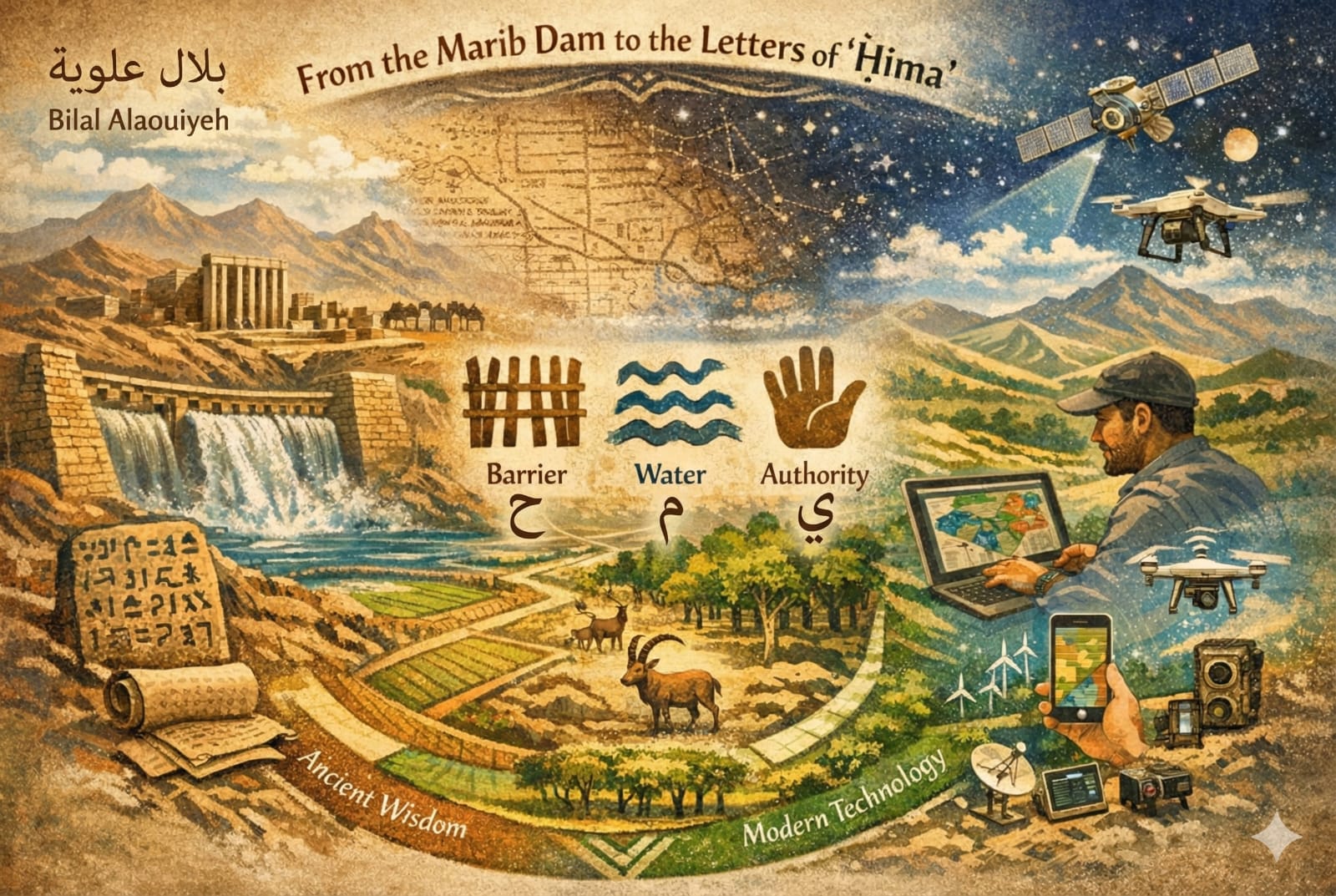
Hima is not a recent invention nor an isolated historical practice. Rather, it represents a surface layer built upon a deep structural foundation formed through the continuous overlap of Proto-Sinaitic letter memory, a Sabaean water–institutional experience, and an Arab–Islamic crystallization of environmental governance.
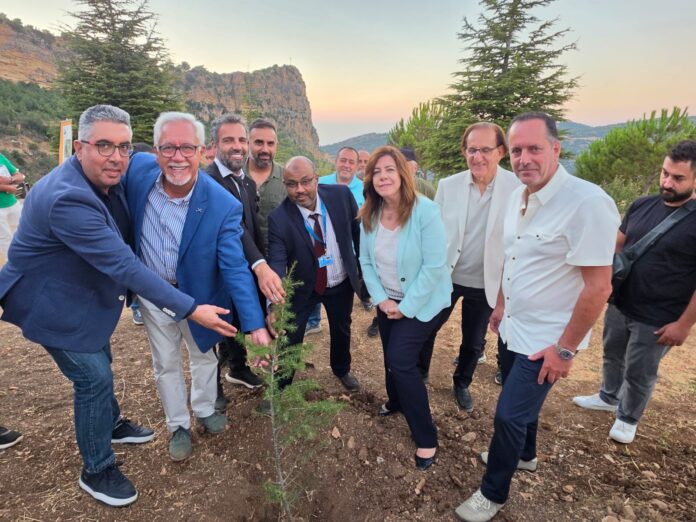
Accordingly, the revival of Hima today through modern initiatives—most notably those led by the Society for the Protection of Nature in Lebanon (SPNL)—does not constitute merely a contemporary resource-management tool, but rather a conscious continuation of a civilizational trajectory extending nearly four thousand years.
From this perspective, the evolution of the concept of Hima can be read through four interconnected historical levels:
First: The Level of the Letter
(Proto-Sinaitic, ca. 1900–1500 BCE)
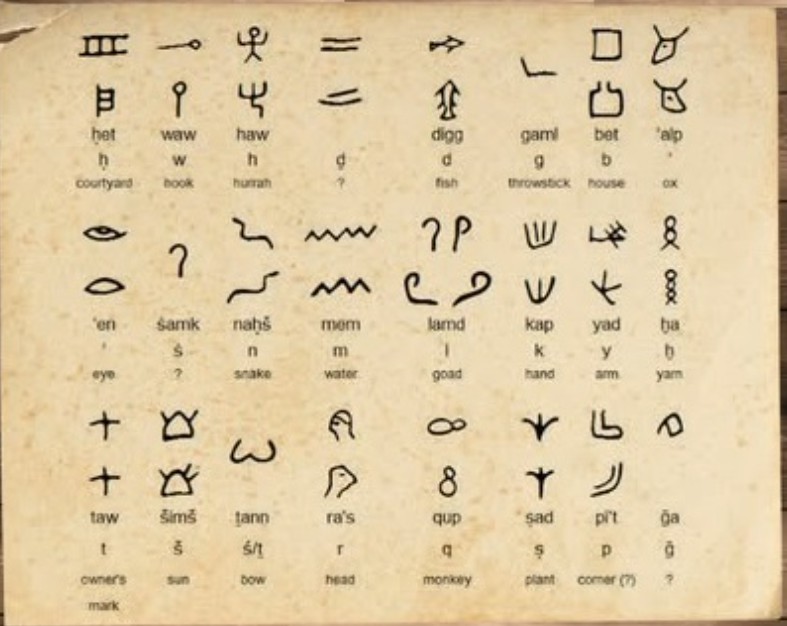
The earliest structure of the root Ḥ–M–Y is revealed in the pictographic meanings of Proto-Sinaitic letters:
- Ḥ = fence / boundary
- M = water / life
- Y = hand / authority
Thus, the structure of the root itself forms a clear conceptual equation:
A boundary that protects water through authority.
This meaning derives from the origins of the letters ḥ, m, y in the Proto-Sinaitic writing system, which developed between the nineteenth and sixteenth centuries BCE—approximately 3,500–3,900 years ago.
Second: The Sabaean Linguistic Level
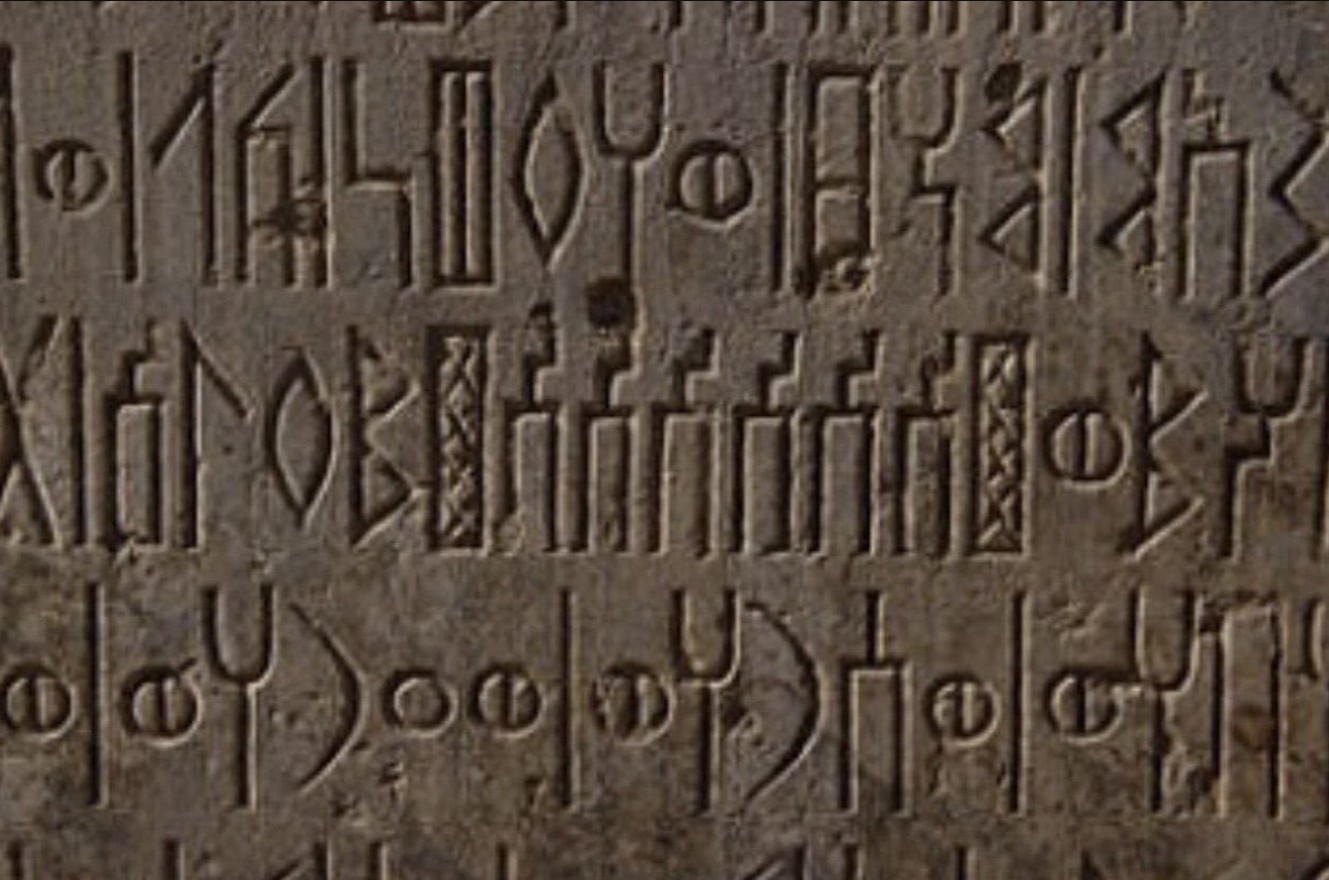
(Sabaean florescence ca. 800 BCE – 275 CE)
In South Arabia, within the institutional context of the Kingdom of Sabaʾ, the root appears in a clear linguistic form:
Maḥmā (𐩣𐩢𐩣𐩺) (Sabaean language)
meaning: a protected or forbidden domain.
This usage demonstrates that the root Ḥ-M-Y functioned semantically within the field of protection and restriction prior to its crystallization in Classical Arabic, embedded within an administrative–hydraulic system linked to resource regulation.
The Kingdom of Sabaʾ flourished approximately from the eighth century BCE to the third century CE—about 2,300–2,800 years ago.
Third: The Arab and Islamic Level
(From the 1st century CE to the present, with juristic crystallization from the 7th century)
In the pre-Islamic Arab context, the concept of Hima was used to protect pastures and water sources for tribal leaders.
With the advent of Islam, Hima was transformed from a tribal instrument into a juristic–administrative system governed by public interest and ethical principles. This transformation began in the seventh century CE during the time of the Prophet Muhammad ﷺ, with the establishment of the Hima of Medina and the designation of protected resources for charity and cavalry.
Subsequently, Islamic jurisprudence expanded and refined the concept between the eighth and eleventh centuries and beyond, producing nearly 1,400 years of continuous institutional reflection on the protection of natural resources.
Fourth: The Contemporary Level
(SPNL – 20th and 21st centuries)
In the modern era, SPNL reconnects this historical, linguistic, and ethical continuum by transforming Hima into a practical framework for community-based environmental governance in Lebanon and the Arab world.
Since the late twentieth and early twenty-first centuries, the Hima model has been revived in sites such as Anjar, Kfar Zabad, Ibl El-Saqi, and others, bringing the total number of officially recognized Hima sites to more than forty across the entire Lebanese territory. This approach integrates:
- Text (language),
- Inscription (Sabaean epigraphy),
- Practice (resource management and ecological justice).
In doing so, the concept is granted renewed vitality after nearly two thousand years since its last direct Sabaean manifestation.
Conclusion
From this historical trajectory, it can be concluded that the word “Hima”, in its deep semantic sense, originates from:
- The original Semitic root (Ḥ-M-Y) shared across early Semitic languages, whose first pictographic expressions appear in Proto-Sinaitic writing (fence – water – hand) between the nineteenth and sixteenth centuries BCE—approximately 3.5–3.9 millennia ago.
- The ancient South Arabian environment, particularly the Sabaean tradition, which employed forms such as Maḥmā (𐩣𐩢𐩣𐩺) to denote protected or forbidden areas during the Sabaean florescence (ca. 800 BCE – 275 CE).
- The Arab and Islamic heritage, which inherited and further developed the concept from the seventh century CE onward into a comprehensive institutional system for the protection of pastures and water resources.
Today, the spirit of this system is reactivated through SPNL’s initiatives in the twenty-first century, within a continuous historical arc approaching four thousand years. In this process, Hima evolves into the “Smart Hima” model—an epistemological and technological extension of traditional environmental governance rather than a rupture from it. Through the integration of Hima’s ethical and institutional values with modern tools such as Geographic Information Systems (GIS), remote sensing, digital environmental monitoring, evidence-based decision-making, and community participation, Hima becomes a living, measurable, and adaptive system capable of responding to the challenges of climate change, biodiversity loss, and environmental justice.
The Story of Hima Across Four Thousand Years
How Did We Arrive at the Figure of Four Thousand Years?
The Chronological Sequence of the Hima System
To accurately and methodologically demonstrate the temporal depth of the Hima system, historical phases are not added cumulatively as isolated periods, but rather understood as successive stages along a single, continuous timeline that begins with the earliest symbolic articulation of protection and extends to the present day.
🔹 Phase One: Symbolic Foundation (Proto-Sinaitic Period)
From 1900 BCE to 800 BCE = 1,100 years
This phase represents the earliest documented emergence of symbolic awareness related to protection and resource regulation, as reflected in Proto-Sinaitic writing through the pictographic meanings of letters (Fence – Water – Hand). At this stage, the concept of Hima existed as an idea and symbolic structure, prior to its transformation into an institutional system.
🔹 Phase Two: Institutional Organization (Sabaean Period)
From 800 BCE to 275 CE = 1,075 years
With the formation of the Kingdom of Saba in southern Arabia, the concept of Hima evolved from a symbolic notion into a written water-administrative and institutional system linked to land and water management. Sabaean inscriptions record terms such as Maḥmā (𐩣𐩢𐩣𐩺)—written in the Sabaean script—to denote a protected or prohibited domain, confirming the formalization of protection within state governance.
🔹 Phase Three: Transitional Arab Period
From 275 CE to 610 CE = 335 years
This phase represents a transitional period between the decline of the Sabaean institutional system and the emergence of Islam. During this time, Hima practices persisted within Arab customary traditions, yet without a unified ethical or legal framework.
🔹 Phase Four: Islamic Environmental Governance
From 610 CE to 2025 CE = 1,415 years
Beginning with the Prophetic mission of Muhammad (peace be upon him), Hima crystallized into a jurisprudential and administrative system grounded in public interest and ethical restraint. This framework continued to evolve throughout Islamic history, shaping long-standing approaches to environmental stewardship and resource protection up to the modern era.
🔹 Phase Five: The Present – Smart Hima (SPNL)
Late 20th century – 2025 (within the Islamic continuum)
In the contemporary period, the Hima system is being revived and advanced into the Smart Hima model through initiatives led by the Society for the Protection of Nature in Lebanon (SPNL). Smart Hima represents a modern framework for community-based environmental governance, integrating scientific knowledge and digital technologies while maintaining continuity with Hima’s historical and ethical foundations.
🔢 Final Chronological Calculation
- 1,100 years (Proto-Sinaitic phase)
- 1,075 years (Sabaean phase)
- 335 years (Transitional Arab phase)
- 1,415 years (Islamic phase until 2025)
Total = 3,925 years
This temporal span is academically expressed as:
approximately four thousand years of continuous development of the Hima system.
Methodological Conclusion
This chronological analysis demonstrates that Hima evolved along a single, uninterrupted civilizational trajectory—originating as a symbolic concept, transforming into an institutional system, crystallizing within an Islamic ethical-legal framework, and today being re-activated as a model of smart environmental governance extending through 2025.
Author
Bilal Alaouiyeh
Certified expert in Geographic Information Systems (GIS) and Remote Sensing, specializing in environmental governance, water resource management, and spatial analysis. His work focuses on integrating advanced spatial methodologies with historical, linguistic, and cultural analysis to reinterpret how ancient civilizations managed environmental and social sustainability, and to activate these deep knowledge roots within contemporary environmental governance models—most notably the Smart Hima framework.
Sunday 28-Dec-2025