

From the Arctic to Africa, migratory birds connect continents, ecosystems and people. In Nairobi, the global conservation community gathered to protect the invisible highways they depend on.
By Raghida Haddad
Every year, as seasons change, an extraordinary drama unfolds above our heads.
Birds leave their breeding grounds and take to the skies, crossing mountains, deserts, seas and national borders on journeys spanning thousands of kilometres. Some cross entire oceans. The Arctic tern, for example, can travel more than 80,000 kilometres in a year between the Arctic and the Southern Ocean.
Yet the journey is becoming harder.
When conservationists, scientists, governments and financial institutions gathered in Nairobi, Kenya, for the BirdLife International Global Flyways Summit, the message from science was unmistakable: the world’s migratory birds are in trouble. The newly released State of the World’s Birds 2026 report found that 45% of migratory bird species are declining, while one in nine is threatened with extinction.
Held from 8 to 11 September and co-hosted by BirdLife International and Nature Kenya, the summit brought together people from across the world to confront a problem no country can solve alone.
Because birds do not stop at borders.
A journey of many links
A flyway is much more than a line drawn across a map. It is an interconnected network of breeding grounds, stopover sites, wetlands, forests, grasslands, coastal areas and non-breeding habitats that birds need throughout their annual cycle. Break one link, and the entire journey is at risk.
The 2026 State of the World’s Birds assessed all 1,843 migratory bird species worldwide. While 45% are declining, 30% are stable, 14% are increasing and 11% have unknown population trends. The picture is particularly worrying for some groups: 54% of migratory shorebird species and 49% of migratory seabirds are declining. In the East Asian–Australasian Flyway, 53% of migratory species are in decline, while half of species using the six marine flyways are declining.
The report also reveals the scale of the loss over time. In Europe, long-distance migratory birds declined by about 35% between 1980 and 2024. In North America, long-term monitoring indicates that 419 migratory species lost a net 2.5 billion individuals between 1970 and 2017.
The problem is not simply the number of birds, but the places they depend on. BirdLife’s analysis of 1,099 Key Biodiversity Areas used by migratory birds found that 58% are in poor or very poor condition. More than half of all migratory bird species use wetlands, and nearly a third are highly dependent on them. Over the past three centuries, about 3.4 million square kilometres of inland wetlands—an area roughly the size of India or the whole Arab Peninsula—have disappeared.
The threats are overwhelmingly human-driven. Among the pressures affecting threatened migratory species, BirdLife identifies invasive species and diseases, agriculture, climate change, hunting and trapping, pollution, urban development, fisheries and energy infrastructure. Many species face several of these pressures simultaneously along their journeys.
The disappearance of the Slender-billed Curlew, whose extinction was confirmed in 2025, gave the gathering a poignant reminder of what is at stake. It was the first confirmed global bird extinction in mainland Eurasia and Africa in recent centuries, while six other migratory species have been confirmed or suspected to have disappeared over the past 150 years.
But Nairobi was not a gathering of despair. It was a gathering of action.
From warning to commitment
At the heart of the summit was a simple recognition: protecting migratory birds requires protecting their entire journey.
Governments, scientists, conservation organisations and financial institutions came together around the Nairobi Flyways Declaration, committing to stronger international cooperation to conserve migratory birds and their habitats. More than 100 organisations signed the declaration, signalling growing support for coordinated, flyway-scale conservation.
Princess Takamado of Japan, Honorary President of BirdLife International, captured the essence of the gathering: “Migratory birds do not recognise borders. They connect Asia to Africa, the Arctic to the tropics.”
BirdLife International Chief Scientist Dr Stuart Butchart described migratory birds as sentinels of the health of the natural systems that sustain us, while pointing to an important reason for hope: conservation works when action is coordinated.
Following the money
One of the most significant developments in Nairobi was the financial sector’s involvement. Three multilateral development banks are integrating flyway conservation into their lending frameworks, with commitments since 2021 exceeding US$6 billion. The Asian Development Bank is mobilizing US$3 billion over the next decade to protect at least 50 priority wetlands along the East Asian–Australasian Flyway, while the Development Bank of Latin America and the Caribbean plans to mobilise US$3–5 billion through 2050. The World Bank and BirdLife are also mobilizing several billion dollars across flyways in Africa, Europe and Asia.
For Africa, this carries particular significance. As Nature Kenya Executive Director Dr Paul Matiku reminded participants, African countries are not merely places where migratory birds arrive after crossing continents. They are stewards of solutions. The wetlands, grasslands and forests of Africa are indispensable to birds that breed in Europe, Asia and the Arctic. Conservation, development and human wellbeing are increasingly understood as interconnected.
Hope along the flyway
Amid the alarming statistics, Nairobi also offered evidence that change is possible.
The State of the World’s Birds report documents examples in which coordinated conservation has helped wildlife recover. In the African-Eurasian Flyway, international action for the Egyptian Vulture has halted the decline of its Balkan breeding population. Elsewhere, habitat restoration and the removal of invasive species have enabled migratory bird populations to return.
The lesson is clear: the flyway itself must become the unit of conservation. A wetland cannot be protected in isolation if the bird feeding there later faces destroyed habitat elsewhere. A breeding island cannot be made safe if the same birds are caught in fishing gear thousands of kilometres away.
The sky may appear limitless, but the birds’ world is not.
From Nairobi to Hima: Bringing the Flyway Home
Perhaps the most important question after Nairobi is not what was agreed in the summit hall, but what those commitments will mean on the ground. The answer may lie in an approach that begins with people and the places they call home: Hima.
Rooted in a long tradition of community-based stewardship in the Middle East, Hima sees conservation not simply as setting land aside from people, but as creating shared responsibility between communities and nature. In its modern revival, Hima brings together local knowledge, sustainable use of natural resources, biodiversity conservation and community participation.
In this sense, Hima and the Nairobi Flyways approach speak the same language. A migratory bird may breed in one country, stop to feed in another and spend the winter somewhere else. Its survival depends on the health of the entire chain.
Hima begins at one of those links. A wetland, forest, mountain, grassland or coastal area becomes more than a dot on a conservation map when the people living there become its guardians. Through community participation, local institutions and sustainable management, Hima can help keep these places healthy for both people and wildlife.
The Role of Communities in Protecting Migratory Birds
This is where Nairobi’s global vision meets the reality of landscapes. The Nairobi Flyways Declaration calls for cooperation across borders and for conservation to be integrated into development and finance. Hima brings that ambition to the community level, where decisions about water, grazing, farming, forests and wetlands are made every day.
This is particularly relevant to the African-Eurasian Flyway, which links Europe, the Middle East and Africa. The birds that arrive in African wetlands do not belong to one country. Their journey belongs to the whole flyway—and so does the responsibility for their protection.
There is already a living example of this connection in Lebanon. Since 2004, the Society for the Protection of Nature in Lebanon (SPNL), BirdLife International’s national partner, has been reviving Hima as a model of community-based conservation, working with municipalities and local communities to protect habitats and biodiversity while supporting sustainable use of natural resources.
This gives the Nairobi message a very human dimension. The future of migratory birds will depend not only on international agreements and conservation finance, but also on people on the ground: a farmer protecting a wetland, a shepherd managing grazing sustainably, a municipality caring for a landscape, young people monitoring birds, or a community choosing to protect a natural resource for the next generation.
The flyway provides the global vision; Hima provides the local action. Together, they offer a way of seeing conservation not as a collection of isolated protected areas, but as a living network of people, places and ecosystems connected across seasons and borders.
Perhaps that is where the real journey begins—not in the sky, but on the ground, with people choosing to become guardians of the places through which the great migration passes.
Raghida Haddad is Editor-in-Chief of SPNL’s Al Hima magazine
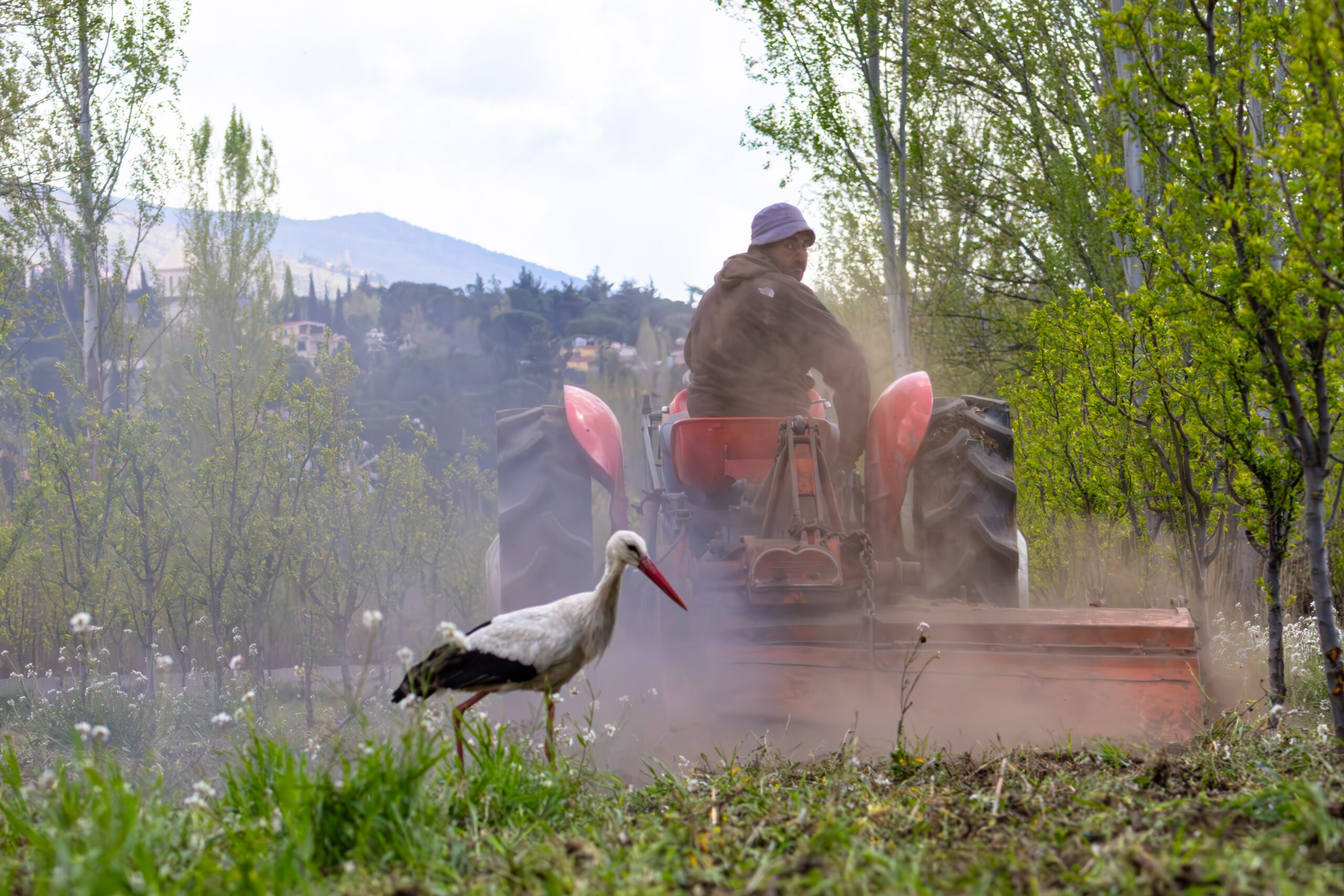
Photo: A migrant stork feeding on farmland in Hima Anjar, Lebanon (by Tsolag Hergelian)