

The turkey was Benjamin Franklin’s choice for the United States’s national bird. The noble fowl was a favored food of Native Americans. When Europeans arrived, they made it one of only two domestic birds native to the Americas—the Muscovy duck shares the distinction.
 Yet by the early 20th century, wild turkeys no longer roamed over much of their traditional range. They had been wiped out by hunting and the disappearance of their favored woodland habitat.
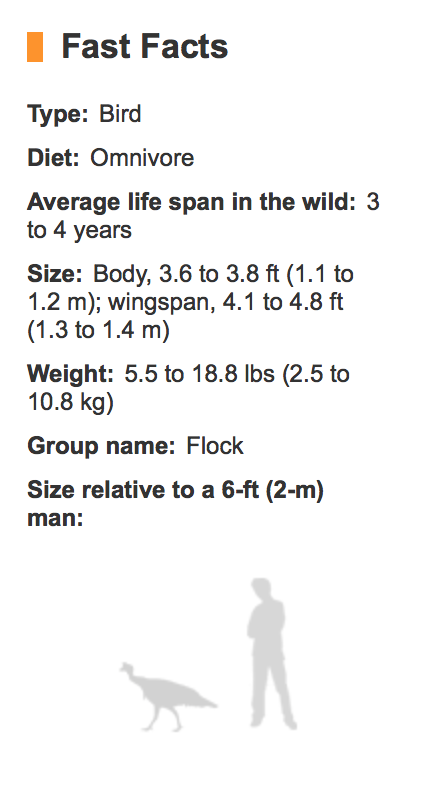
Wild turkeys typically forage on forest floors, but can also be found in grasslands and swamps. They feed on nuts, seeds, fruits, insects, and salamanders.
Wild turkey reintroduction programs began in the 1940s, and the birds were relocated to areas where populations had been decimated but woodlands were recovering. Such efforts worked so well that wild turkeys now live in areas where they may not have occurred when Europeans first reached the Americas. Today, flocks are also found in Hawaii, Europe, and New Zealand.
Only male turkeys display the ruffled feathers, fanlike tail, bare head, and bright beard commonly associated with these birds. They also gobble with a distinctive sound that can be heard a mile (a kilometer and a half) away.
Females lay 4 to 17 eggs, and feed their chicks after they hatch—but only for a few days. Young turkeys quickly learn to fend for themselves as part of mother/child flocks that can include dozens of animals. Males take no role in the care of young turkeys.
Domestic turkeys have white-tipped tails because they are the descendants of a Mexican subspecies that was taken to Europe for domestication in the early 16th century. The feature distinguishes them from most modern wild turkeys, though captive diet, lifestyle, and breeding have caused other physical discrepancies.
Source: http://animals.nationalgeographic.com