

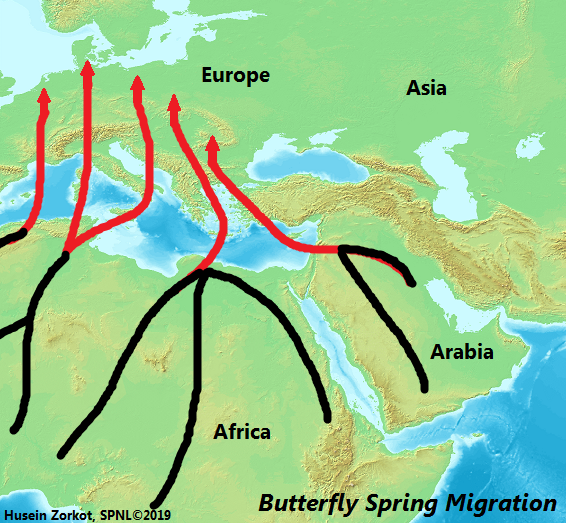
Heavy rains in the drier parts of the Arabian Peninsula and Africa led to a surge in the spring populations of painted lady (Vanessa cardui) butterflies. Under pressure to secure food and avoid competition, billions of these butterflies embarked on a mass migration through Lebanon and the Levant, crossing the Mediterranean Sea to Cyprus and onward to Europe. Meanwhile, some remained behind, establishing resident populations.
These butterflies make a one-way journey to temperate regions where they breed, with the next generation set to migrate to Africa in the autumn. Some experts speculate that Lebanon and the Levant have not witnessed such a large-scale migration since 1917. Although researchers are still investigating the exact mechanisms behind this phenomenon, it is believed that these white, yellow, and brown butterflies—often regarded as drab, mothlike, and unattractive—traverse Mediterranean islands such as Cyprus, Crete, Sicily, Corsica, and the Balearics. They likely pause on these islands to feed on wildflowers, replenishing their energy reserves for the long intercontinental flight ahead.
The painted lady is a cosmopolitan species with a worldwide distribution that relies on a wide variety of host plants, including members of the Compositae, Brassicaceae, and Malvaceae families, as well as numerous other species. These include several agriculturally important crops such as radishes, lettuce, strawberries, tobacco, citrus, rice, and maize. In regions where it is resident, this butterfly is among the first species to emerge in spring and is known for producing many generations throughout the year, flying continuously during the spring, summer, and autumn—or year-round in warmer climates.